
January 27, 2026
STAY INFORMED – TALKING POINTS – ACTIONS TO CONSIDER – STORIES MAKING NEWS


International Holocaust Remembrance Day honors the 6 million Jews murdered by Nazi Germany and confronts the historical realities of the Holocaust. Amid alarming trends, this commemorative day preserves historical truth in the face of rising ignorance, distortion and denial that place society at large – and the Jewish community in particular – at risk of repeating history.
Declining Knowledge
January 27 marks the observance of International Holocaust Remembrance Day – that honors the liberation of Auschwitz-Birkenau – the largest Nazi killing center and a site that has come to symbolize the culmination of a genocide. The UN established the commemoration on Nov. 1, 2005 – more than 60 years after the end of the Nazi genocide.
As the Holocaust recedes further into history, public understanding of what happened – and how it happened – is weakening, if not altogether disappearing. Recent surveys in the U.S. and Europe reveal significant gaps in basic Holocaust knowledge, particularly among younger generations:
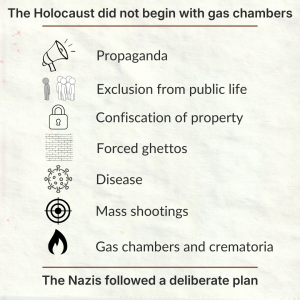
The Nazi government spread propaganda about Jews, excluded them from universities, confiscated their businesses and forced them into ghettos. Death followed through disease, mass shootings and gas chambers.
Adolf Hitler and the Nazi regime pursued a deliberate plan to eliminate Jews – formalized at the 1942 Wannsee Conference – where officials coordinated the systematic extermination of Europe’s Jewish population as a first step toward murdering Jews worldwide.
Entire family lines were erased, communities destroyed and future generations never born. The number of Jews in the world today is about 16 million – slightly less than before the Holocaust – despite a global population that has more than quadrupled. This demographic reality is a direct consequence of the genocide.
Erasing Jews from Holocaust Education
As the number of Holocaust survivors continues to decline – from 3.5 million in 1945 to only 197,000 today. Memories from history are mainly passed down to future generations through education. Despite the concerning knowledge gaps, large majorities of Americans and Europeans support Holocaust education. There are growing concerns, however, that some teachers’ unions and educators now minimize the Holocaust – or outright refuse to teach the topic.
America’s largest teachers’ union “promotes the celebration of International Holocaust Remembrance Day to recognize the more than 12 million different victims of the Holocaust from different faiths and other targeted characteristics.” As prominent Holocaust scholar Dr. Rafael Medoff noted, “The ‘12 million’ figure was calculated by combining the fatality numbers among various people who suffered in the war, but who were not targeted by the Nazis for mass annihilation – and without mentioning Jews.”
In the UK, the number of schools commemorating the Holocaust has declined by nearly 60% since the brutal Oct. 7 Hamas massacre and the ensuing war. A Jewish teacher reported that students at her school tried to insert a reference to the ‘Gaza genocide’ into a Remembrance Day statement last year. Some teachers cancelled their Holocaust lessons because they lack confidence in addressing certain issues, while others only commemorate it under certain conditions – including condemning the Israeli government.
The removal of Jewish identity from Holocaust history is not limited to classrooms. It is increasingly reflected in cultural and media portrayals. The BBC recently aired a show about the Kindertransport that rescued 10,000 children from Nazi territory – bringing them to the UK, without mentioning that nearly all the children were Jewish. British-American actress Dame Helen Mirren mentioned Jews in her interview for the show – but it was edited out.
Holocaust Distortion: Denial, Inversion and Politicalization
As public understanding weakens, the Holocaust is increasingly forgotten or even worse: denied, trivialized or repurposed to shock, accuse or delegitimize political targets – rather than to explain history.
The International Holocaust Remembrance Alliance has identified 10 forms of Holocaust distortion, including intentional efforts to minimize the Holocaust, excuse the role of collaborators, blame Jews for their own persecution and apply Holocaust language and imagery to unrelated political, ideological or commercial purposes.
Alarmingly, some groups – including radical Muslims and white supremacists – promote conspiracy theories that deny the Holocaust happened while simultaneously claiming that Jews exploited their own trauma for political gain. Antizionists routinely use Holocaust inversion to recast Jews as the new Nazis – portraying Israel as equivalent to Nazi Germany. They also falsely equate Nazism with Zionism – the right of Jews to have a country in their ancestral homeland.
Holocaust language has repeatedly been politicized across ideological lines. COVID policies were compared to Nazi laws – some protesters wore yellow stars imposed by the Nazis on Jews, Maryland Rep. Daniel Cox invoked the Nuremberg Trials of Nazi war criminals for his opposition to a children’s mental health bill, critics condemned a migrant detention center in FL as Alligator Auschwitz and MN Gov. Tim Walz recently compared some children in his state to murdered Jewish teen Anne Frank.
Holocaust analogies are not new. In 2018, U.S. Holocaust Memorial Museum historian Edna Friedberg cautioned that labeling political opponents as Nazis or invoking Hitler for moral condemnations exploits Holocaust memory as a rhetorical weapon – at the expense of productive discussions on real societal issues. The ADL also has condemned the use of analogies in the public square.
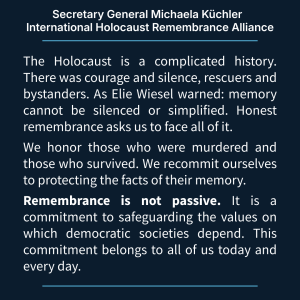


Holocaust remembrance requires deliberate engagement with accurate history, survivor testimony and educational resources that preserve its meaning rather than dilute it.
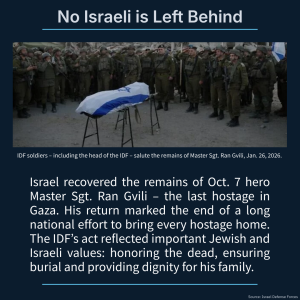

Stories Impacting American Jews
Stories Impacting the U.S. and Israel
Stories from Around the World
Stay Informed | Speak Up | Take Action

Want to Read More of Our Talking Points? Did you miss a recent edition of The Focus Project? No need to search your inbox. Our most recently published editions are available on our website.
This content is developed by The Focus Project in partnership with MERCAZ USA. The Focus Project distributes weekly news and talking points on timely issues concerning Israel and the Jewish people, including antisemitism, anti-Zionism and the delegitimization of Israel. It represents a consensus view across a spectrum of major American Jewish organizations. MERCAZ USA recognizes and respects the diversity of views on these issues among its readers and the community at large.