
January 20, 2026
STAY INFORMED – TALKING POINTS – ACTIONS TO CONSIDER – STORIES MAKING NEWS


On the day that honors the legacy of the Rev. Dr. Martin Luther King Jr., some anti-Israel activists have exploited his memory to promote their own political agendas – many that alienate Jewish Americans. Language long used to demonize Jews is being adopted across a range of ideological movements – contributing to a rise in intimidation, exclusion and attacks against Jewish communities nationwide. These trends show how Dr. Martin Luther King Jr.’s legacy is being distorted and abused in contemporary activism to fuel antizionism and antisemitism – and damage the historically strong and collaborative Black-Jewish alliance.
Antizionists are Hijacking MLK Day Events
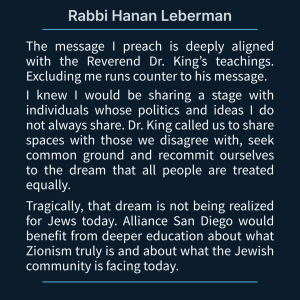
Organizations that claim the language of civil rights are increasingly using MLK Day to exclude Jews from civic participation. Alliance San Diego disinvited Rabbi Hanan Leberman from giving a benediction blessing at this year’s All Peoples Celebration – because of his “Zionist views.” The event’s organizers present their mission as an “inclusive democracy where everyone can participate fully with dignity.”
The San Diego Board of Rabbis and Cantors condemned the decision: “There was never a litmus test for Jewish clergy to speak at this event. This year’s decision sends a message that there are conditions placed on our participation in public life, that our identities must be edited or disavowed to be deemed acceptable.”
The American-Israeli rabbi, who served in an Israeli counterterrorism unit, responded:
Across multiple cities, some anti-Israel activist groups have repurposed MLK Day programming into ideological teach-ins marketed to families with children as young as six. NYC Educators for Palestine hosted a “Palestine Teach-In.” NYC Public School Alliance President Karen Feldman called the event an “attempt to indoctrinate young people into hating Jews.”
Philadelphia Educators for Palestine, the Students for Justice in Palestine Coalition, Racial Justice Philly and the Asian Arts Initiative promoted “From Philly To Palestine: How Our Struggles Intertwine.” An event flyer falsely claimed that American federal aid to Israel is responsible for a lack of state funding for public schools.
These incidents reflect a broader trend in which Jewish participation is increasingly conditioned on political conformity unrelated to the purpose of public commemoration.
Tropes and Attacks Against Jews Reemerge Across Ideological Lines
Black-Jewish alliances were forged in response to shared explicit threats from organized extremist movements. Cooperation during the Civil Rights Movement in the 1960s emerged in response to violent attacks, discrimination and inflammatory rhetoric against Black and Jewish Americans. White supremacists – especially the Ku Klux Klan – were the main instigators. Earlier alliances formed because of threats posed by Nazi and fascist movements in the U.S. and Europe.
A bomb planted by the KKK severely damaged the administrative offices of the Beth Israel Synagogue in 1967 in Jackson, Mississippi. The white supremacist group also detonated a bomb in front of home of the congregation’s rabbi, Dr. Perry Nussbaum – a civil rights activist. Following the synagogue bombing, the Greater Jackson Clergy Alliance – the first racially integrated association of Protestants, Catholics and Jews in MS – marched in the Walk of Penance to the synagogue to show support. White supremacists bombed and burned down dozens of churches – mainly Black churches – in the 1960s.
The same synagogue recently was set on fire by a 19-year-old white attacker. The arsonist intentionally targeted the city’s only synagogue – calling it a “synagogue of Satan.” This language has historically been used by extremists to justify attacks against Jews. In recent years, this vile message has been amplified by Louis Farrakhan’s Nation of Islam, Black Hebrew Israelite groups and the QAnon conspiracy theorists. Far-right Black American political commentator Candace Owens also has recently spread the phrase.
Local church leaders again offered support to the local Jewish community following the arson attack. NAACP President Derrick Johnson echoed the words of MLK: “We should be even more vigilant and accepting of one another and all that we bring to the table.” Synagogue President Zach Shemper defiantly stated: “We’re still here, and we’re not going anywhere.”
Dr. King’s Legacy Twisted to Fit Anti-Jewish Narratives
Some activists frame hateful conduct against Jews as legitimate political expression – influencing shifts in attitudes among younger Black Americans. These activists promote warped views of Jews and Israel. Compared to all Americans, Black Americans, ages 18 to 34, are more likely to say that acts of hate against Jews in the U.S. are a legitimate form of protest in response to the Gaza War (36% vs. 23%) and justify Hamas terrorism while condemning Israel’s actions (13% vs. 7%). Black Americans also are slightly more likely to support Christian nationalism (34% vs. 30%).
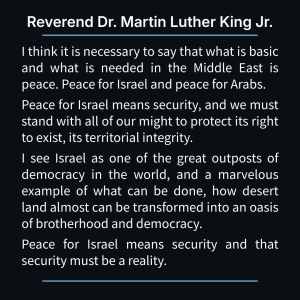
Dr. King’s public record stands in stark contrast to contemporary trends. Following looting of Jewish stores in NY by Blacks in 1964, Dr. King responded: “I solemnly pledge to do my utmost to uphold the fair name of the Jews. Not only because we need their friendship – but mainly because bigotry in any form is an affront to us all.
Speaking at the 1968 Rabbinical Assembly Convention – just 10 days before he was assassinated – Dr. King powerfully declared:

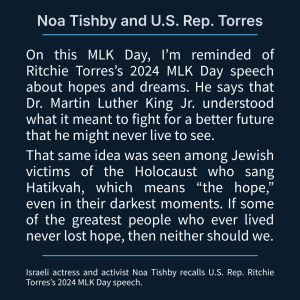

Support organizations advancing Black-Jewish cooperation beyond rhetoric.

Stories Impacting American Jews
Stories Impacting the U.S. and Israel
Stories from Around the World
Stay Informed | Speak Up | Take Action

Want to Read More of Our Talking Points? Did you miss a recent edition of The Focus Project? No need to search your inbox. Our most recently published editions are available on our website.

This content is developed by The Focus Project in partnership with MERCAZ USA. The Focus Project distributes weekly news and talking points on timely issues concerning Israel and the Jewish people, including antisemitism, anti-Zionism and the delegitimization of Israel. It represents a consensus view across a spectrum of major American Jewish organizations. MERCAZ USA recognizes and respects the diversity of views on these issues among its readers and the community at large.