
December 30, 2025
BACKGROUND – TALKING POINTS – ACTIONS TO CONSIDER – STORIES MAKING NEWS


The Jewish community enters the new year with renewed clarity and determination despite the significant and deadly challenges faced in 2025. This past year has stripped away any remaining illusions: anti-Jewish hate became more explicit, more violent and more politically normalized – in the U.S. and around the world.
From the Fringes to the Mainstream: Normalization of Hate
Narratives once considered fringe are increasingly gaining support along the ideological spectrum – signaling a broader normalization of hostility toward Jews. The election of Zohran Mamdani as mayor of NY – the city with the world’s largest Jewish population – deeply alarmed Jewish communities nationwide. The ADL found that more than 20% of his transition team appointees have extremist backgrounds. One official resigned after a past tweet about “money hungry Jews” was revealed, while others supported the Hamas massacre of Israelis on Oct. 7, 2023.
Political polarization from the far left and far right increasingly threatens Jews – and America. Some leaders on the left increasingly tolerate anti-Jewish hate when it is framed as anti-Zionism. On the other side of the aisle, the same language is increasingly being used, as support for Israel declines. A recent Jewish People Policy Institute report noted a surge in anti-Jewish hate on the right from powerful influencer Candace Owens, while commentator Tucker Carlson hosted white supremacists and Holocaust deniers on his social platforms that reach millions of followers.
Recently, a Democratic candidate for local council in Maryland blamed “Zionists” – a common proxy for Jews – for controlling politics and, in Florida, a Republican candidate for governor blames the state’s investments in Israeli bonds for the state’s housing crisis.

Violence and Fear in Everyday Jewish Life
There were several major terrorist attacks targeting Jews around the world this year:
There were countless other attacks, including beatings, intimidation and vandalism. Many attacks were prevented – but too many instances of glorification and incitement continue. In NYC, some Jewish teens are masking their names: Sivan became Alexandra, Noa is now Nina and Michal goes by Micky when using Uber or ordering coffee at Starbucks. In the UK, a majority of British Jews reportedly feel they no longer have a future in their country. The rise of attacks against Jews resulted in sharp rises in immigration to Israel from Western countries.
Choosing Visibility Amid Sea of Rising Hate
While Jews are taking security precautions to protect themselves and their families, many have strengthened their Jewish identity. Jews across the U.S. and around the world strengthened communal bonds, increased public expressions of Jewish life and engaged more visibly and confidently in civic and cultural spaces. From public Hanukkah menorah lightings to expanded communal programming, Jewish identity was asserted openly as an act of resilience and defiance.
While some young Jews are altering their names in NYC, others are doubling down. Rebecca stated: “If I go into a Starbucks and hear something antisemitic (anti-Jewish), I would say my name is Rivka – my Hebrew name.” A teenage boy defiantly uses his name, as he explained, “in the Jewish religion it acknowledges the individuality of each person.”
A new Chabad Jewish community center is being built at the site of the horrific Bondi Beach massacre in Australia. It is named after the Chabad emissaries, Rabbi Eli Schlanger and Rabbi Yaakov Levitin, who were murdered in the attack. In a powerful display of solidarity, tens of thousands of Australians solemnly commemorated the attack at a public menorah lighting.
Israel Helps Shape a New Middle East
Jan. 1, 2026, looks entirely different than Jan. 1, 2025, because of significant Israeli military and strategic victories that have benefitted America, Israel and the broader Middle East. A year ago, Iran’s nuclear program was a major threat, dozens of Israeli hostages remained in Gaza and Iran’s proxies were attacking targets across the region with growing and unrelenting intensity. The year ended with an entirely different landscape.
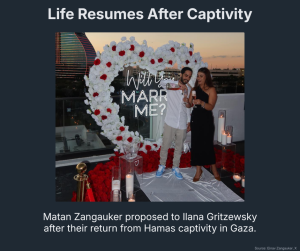
The return of the remaining living hostages – and the remains of the deceased, except for one – allowed families to start healing and rebuilding after two years in brutal captivity. Former hostages have begun reclaiming their lives – including the ordinary milestones they had missed in captivity. Matan Zangauker recently proposed to Ilana Gritzewsky – they both were kidnapped by terrorists from Kibbutz Nir Oz. Zangauker’s mother tweeted a picture celebrating, calling it: “My picture of victory.”
Israel delivered significant military blows across multiple fronts, weakening Iran and its proxies, including Hamas in Gaza, Hezbollah in Lebanon and the Houthis in Yemen. Questions about disarming Hamas and Hezbollah remain, but Israel’s accomplishments have already reshaped the regional balance of power in ways that advance American interests in stability and deterrence. This reality was reflected in the recent meeting between Prime Minister Netanyahu and President Trump, as both leaders discussed regional security and next steps. The Israel Prize – the country’s top honor – will be awarded to Trump for his “special contribution to the Jewish people.”
Looking Ahead to 2026: Hope and Vigilance
Universities remain a major concern, but some institutions have begun taking incidents more seriously, strengthening enforcement and reassessing policies following civil rights settlements with the federal government. Concerns also are increasing in K-12 education where anti-Israel activism has increasingly entered classrooms – in some cases with the support of teachers’ unions.
Significant risks also remain abroad. Even as the war in Gaza has largely ended, it remains unclear whether Hamas and Hezbollah will disarm and whether Iran will again escalate regional threats. Reports that Iran may be advancing biological and chemical missile capabilities underscore the need for continued vigilance in a volatile region.
Domestically, anti-Zionism continues to gain mainstream acceptance and is increasingly used as a substitute for anti-Jewish hatred. Activists across the political spectrum – from the Democratic Socialists of America to newly emerging right-wing conservatives – persist in demonizing Jews to advance their political agendas.
Cautious optimism rests on the possibility that anti-Jewish hatred can be confronted more directly by leaders, institutions and civil society. Some political leaders – U.S. Senators Ted Cruz and John Fetterman – are addressing the ideologies fueling hate within their own parties. Many leaders also acknowledged that the same ideologies that threaten Jews – especially radical Islam – also pose a threat to America and Western democracies.


In light of the challenges and opportunities ahead, individuals, leaders and organizations can help play a role in shaping a safer and more resilient society.

Stories Impacting American Jews
Stories Impacting the U.S. and Israel
Stories from Around the World
Stay Informed | Speak Up | Take Action

Want to Read More of Our Talking Points? Did you miss a recent edition of The Focus Project? No need to search your inbox. Our most recently published editions are available on our website.


This content is developed by The Focus Project in partnership with MERCAZ USA. The Focus Project distributes weekly news and talking points on timely issues concerning Israel and the Jewish people, including antisemitism, anti-Zionism and the delegitimization of Israel. It represents a consensus view across a spectrum of major American Jewish organizations. MERCAZ USA recognizes and respects the diversity of views on these issues among its readers and the community at large.