
December 23, 2025
BACKGROUND – TALKING POINTS – ACTIONS TO CONSIDER – VOICES – STORIES


As more than 2 billion Christians around the world celebrate Christmas and billions more celebrate their own winter holidays, extremist rhetoric and violent attacks have caused heightened security, canceled events and increased tension across communities. These incidents raised broader questions about how societies respond when extremism is normalized. At the same time, several public responses suggested that light can still shine through the darkness.
Australia: Condemnations After Hanukkah Massacre
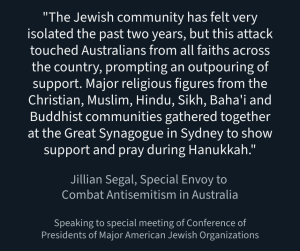
Amid the joyful holiday celebrations held around the world, heightened security with concrete barriers and armed patrols became routine features. In response to the recent Bondi Beach massacre during Hanukkah in Australia, Christians and representatives of other religions expressed their strong support for the Jewish community.
Following the attack where father and son Islamist terrorists murdered 15 Jews at a Hanukkah celebration, condemnations poured in from around the world. Indian Prime Minister Narendra Modi “strongly condemned the ghastly terrorist attack.” The United Arab Emirates “condemned in the strongest terms the terrorist attack that occurred at a Jewish gathering.”
“The cowardly terrorists who massacred innocent people celebrating Hanukkah in Bondi deserve nothing but contempt and swift justice. Their hatred will never break the Jewish community. We stand shoulder to shoulder with Australian Jews, forever,” stated the Imam of Peace, Australian Mohammad Tawhidi, of the Global Imams Council. The imam no longer lives in Australia because of death threats from Islamist extremists and a lack of what he felt was sufficient protection within the country.
The recent Hanukkah massacre in Australia was broadly condemned by a host of unlikely voices, including by the World Council of Churches, which expressed its “solidarity to all our Jewish sisters and brothers threatened by antisemitic hatred and violence.” The Council has a long history of inflammatory comments regarding the Palestinian-Israeli conflict. NYC Mayor-elect Zohran Mamdani denounced the “vile act of antisemitic terror.”
Community Response: Choosing Visibility Over Fear
Acts of solidarity emerged in Australia alongside continued hostility. A Jewish celebrity chef announced the closure of his bagel shop after “two years of constant anti-Jewish harassment,” prompting local residents to plaster his storefront with hundreds of handwritten notes of support. The Muslim hero who disarmed one of the terrorists received a $2.5 million check from donations in recognition of his actions, even as he was branded a “traitor” across parts of the Arab world.
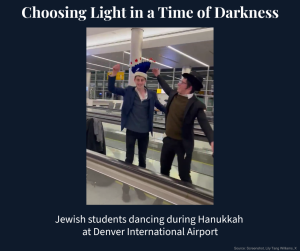
Despite continuing attacks, Jewish life remains visible. Thousands of Australians gathered together to mourn the Hanukkah attack victims. Motivated by the mass shooting, Jewish college students danced openly in the middle of Denver International Airport: “We will not be scared or give in to the darkness, we will only add more and more light.”
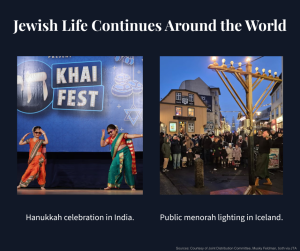
In India, Hanukkah was marked “not with fear, but in belonging, a festival of lights worth celebrating.” And in Iceland, Hanukkah became a rare opportunity for the country’s small Jewish community to come together publicly. Chabad Rabbi Avraham Feldman: “Hanukkah teaches that when many lights stand together, we overpower the darkness.”
Taken together, these moments reflected a deliberate choice – to gather, to mourn and to celebrate openly – even amid heightened threats.
Christmas and New Year’s Eve: Extremists Disrupting Public Holidays
The effects of radical Islamic terror threats have extended beyond the Jewish community – affecting other events and public celebrations. In recent years, Christmas markets and New Year’s Eve events across Europe have been canceled, scaled back or placed under heavy security.
Islamic State publication al-Naba in September called on “monotheistic Muslims to kill by all means Christians and Jews in France.” Islamist attacks were prevented in Germany and Poland. Heightened security concerns caused the cancellation of major New Year’s Eve celebrations in Paris, Belgrade and even Tokyo, with an increased police and counter-terrorism measures in Australia and Germany.
Recently, the FBI arrested five members of a radical left-wing pro-Palestinian group plotting New Year’s Eve bombings against multiple businesses in Southern California – the same group that helped organize the recent violent protest at an LA synagogue. The FBI and Homeland Security cite NYC as an “aspirational target” and the Times Square celebration “an opportunity for obstruction and violence.”
Changing Ideologies: Political Movement Faces a Defining Moment
Recent divisions within the conservative movement were on display at Turning Point USA’s annual conference. TPUSA is a Christian organization that advocates for conservative policies on high school and university campuses – its co-founder Charlie Kirk was assassinated in September.
Leading commentators presented competing visions of the movement’s future. Conservative Ben Shapiro warned of “danger from frauds and grifters who support conspiracy theories and dishonesty, undermining conservative principles.” He criticized Tucker Carlson and Megyn Kelly for refusing to condemn Candace Owen’s conspiracy theories surrounding Kirk’s assassination. Owens has blamed “demonic Zionists.”
Shapiro also criticized Carlson for interviewing Holocaust deniers. Carlson – recently named antisemite of the year – spoke later and found Shapiro’s comments “hilarious.” Vice President JD Vance recently defended Carlson’s place in the conservative movement.
America: Vigilance Remains Amid Attacks
Violent attacks against American Jews continued during Hanukkah – in everyday public settings. In NYC, an assailant declared, “I’m going to kill a Jew today,” before stabbing Elias Rosner in the chest. The Jewish man later stated that “I believe in standing up to bullies and I had the bravery to look him in the eye.” The day before, a man grabbed an Orthodox Jew by the throat on a NYC subway train and threatened to kill him. Mayor Eric Adams condemned the “hateful behavior as deeply offensive to New Yorkers.”
Attacks against Jewish groups on college campuses continued. A suspect was arrested for a recent arson attack on the San Francisco Hillel at San Francisco St. Univ. A man vandalized the Michigan St. Univ. Chabad on consecutive nights – smashing windows and drawing swastikas. The MSU president condemned the attacks, noting they occurred during Hanukkah, “a time centered on light, resilience and faith.” Three vandalism incidents targeted the Jewish community at California State University at Fresno, prompting its president to attend a menorah lighting and advising students to reject hate by “building bridges of understanding.”
From Incitement to Violence: ‘Globalize the Intifada’
Violent chants and fanatical views are tied to attacks around the world and show what happens when leaders fail to act. In Australia, the terrorists condemned “Zionists” before their attack on a Hanukkah celebration. Conspiracy theories blaming Israel for the massacre spread online – including by the mayor of Richmond, CA. Leaders in Australia and Europe have moved to confront the spread of hateful slogans, including “Globalize the Intifada.” British police recently arrested two people for “racially aggravated offenses” after they “shouted slogans for an intifada.” This prompted anti-Israel activists to adopt different Arabic terms also linked to violence.
Direct threats and intimidation continued in other countries. Canadian police arrested three men for attempting to kidnap Jews and women. In Turkey, a mob harassed Jews heading to a menorah lighting, shouting: “Zionists, leave this country.” A French court sentenced a nanny for attempting to poison a Jewish family, while dismissing the antisemitism charge despite her statements about “Jewish money and power.”
A U.S.-based anti-Israel organization launched “The Faces of AIPAC” campaign – using images of board members from the bipartisan American Israel Public Affairs Committee for targeted harassment. The campaign reflects how political hostility toward Israel increasingly spills over into the targeting of Jewish individuals.


Reinforcing community safety supports those affected and encourages responsible leadership:

Stories Impacting American Jews
Stories Impacting the U.S. and Israel
Stay Informed | Speak Up | Take Action

Want to Read More of Our Talking Points? Did you miss a recent edition of The Focus Project? No need to search your inbox. Our most recently published editions are available on our website.
This content is developed by The Focus Project in partnership with MERCAZ USA. The Focus Project distributes weekly news and talking points on timely issues concerning Israel and the Jewish people, including antisemitism, anti-Zionism and the delegitimization of Israel. It represents a consensus view across a spectrum of major American Jewish organizations. MERCAZ USA recognizes and respects the diversity of views on these issues among its readers and the community at large.