
December 2, 2025
BACKGROUND – TALKING POINTS – ACTIONS TO CONSIDER – STORIES MAKING NEWS


A growing number of Jews are being told they may only eat at certain restaurants, participate in organizations and even attend a soccer game if they abandon a core element of their identity – Zionism. In schools, professional fields and community spaces across America, the rise of ideological “purity tests” for Jews deems who are acceptable and who are not. Zionism is the belief that Jews have the right to live in their ancestral homeland. For Jews, Zionism reflects an intersection of family history and deep identity rooted in both pride and tragedy.
Erasing Jews from Society: Zionist Purity Tests
Muslim student organizations at the City College of New York recently announced they would only engage with anti-Zionist Jews – explicitly excluding Jews who identify with Zionism. This followed an university interfaith event where an Islamic speaker led a walkout of Muslim students. They objected to the presence of Ilya Bratman, executive director of the Baruch College Hillel Jewish student group. He stated: “It was 100 percent anti-Jewish. It’s not about Israel. It’s about the Jews.”
The purity tests for Jewish students existed before the Hamas massacres on Oct. 7, 2023, and the ensuing war against Iran-backed terrorists in Gaza. A sexual assault support group at a NY state college campus in 2022 kicked out co-founder Cassie Blotner and Israeli Ofek Preis because they shared an Instagram post explaining how Jews are an ethnic group indigenous to Israel.
USC student government leader Rose Ritch resigned in 2020 after being targeted by a social media campaign that urged fellow students to “impeach her Zionist a**.” Anti-Israel activists subjected her to relentless anti-Jewish harassment and accusations that she was unfit to serve because she was a Zionist. Ritch emphasized that “an attack on my Zionist identity is an attack on my Jewish identity.”
These patterns are not limited to student life. Similar purity tests have emerged in professional fields, cultural spaces and activist circles. Jewish psychologists report being marginalized unless they accept environments where anti-Zionist rhetoric is normalized and Jewish concerns are dismissed. The president of an American Psychological Association division called Zionists “genocidal f*cks.” Harvard Medical School’s Dr. David Rosmarin explained that anti-Jewish hate in the APA “means that there is no room for Jews.” Jewish patients also report too many clinicians allow anti-Zionist beliefs and rhetoric to interfere with their treatment.
The 2019 DC Dyke March banned rainbow flags with the Jewish star – a symbol of queer Jewish identity. Israeli writer Hen Mazzig warned: “Banning the Jewish star is an erasure of millions of Israelis and it makes all Jews feel unsafe in spaces meant to be safe for everyone.”
Exclusionary patterns in all these cases invoke the classic anti-Jewish trope of dual loyalty – the idea that Jews who identify with Israel cannot be trusted – echoing past attempts to spurn Jews and brand them as outsiders.
A recent Jewish People Policy Institute survey emphasized how central Zionism is for American Jews: 82% identify as Zionist or support Zionism, and 88% believe that Israel’s existence is essential for Jews.
#ZionistsNotWelcome: A Disturbing Global Trend
The Dublin city council in Ireland recently voted to rename Herzog Park in response to an anti-Israel petition, before suspending the decision after strong criticism. The park recognizes Ireland-born, former Israeli President Chaim Herzog, “a hero of Europe’s liberation from the Nazis who dedicated his life to pursuing freedom, tolerance and peace.” Activists sought to “permanently rename the park in solidarity with the Palestinian people, in rejection of racist Zionism.” Speaking out in support of her grandfather, Dr. Alexandra Herzog insisted that “Irish Jewish history is part of Ireland’s history. Protect it.”
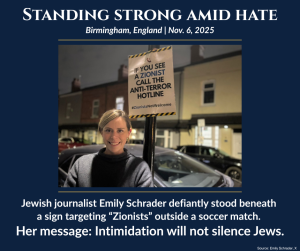
Signs reading, “If you see a Zionist, call the anti-terror hotline #ZionistsNotWelcome,” appeared in Birmingham, England, in November. Masked men posted the signs the night before a soccer game between Israeli team Maccabi Tel Aviv and Aston Villa. Israelis and local Jews were banned from attending the match by the local British police who relied on fake claims spread by anti-Israel activists. Police leaders also inverted reality to falsely blame Israelis for the well-planned violent Jew-hunt in Amsterdam in 2024 after a Maccabi game, when mobs targeted anyone on the street who looked Jewish.
Other incidents illustrate how widespread this trend has become: a Swedish restaurant owner recently announced a ban on Zionists in a social media video, an Israeli family was kicked out of an Italian restaurant and a Toronto business owner declared in 2020 that “Zionists are not welcome in my store.”
Erasing Jewish History: Expulsion from Arab Countries and Iran
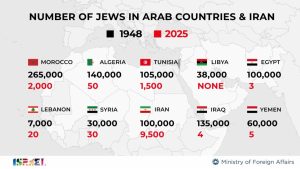
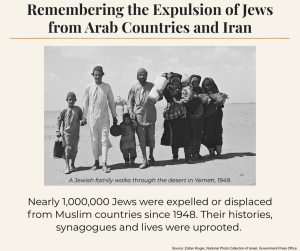
The attempted erasure of Zionist Jews from society echoes an ancient and often overlooked history. In the years following the re-establishment of a Jewish homeland, nearly one million Jews were expelled or forced to flee from Arab countries and Iran – communities that lived across the Middle East and North Africa for millennia. Nov. 30 marked Israel’s official day of commemoration for these expulsions.
These Jews faced systemic discrimination, violence and state-sanctioned persecution: their citizenship was revoked, property confiscated, synagogues destroyed and entire communities uprooted. Jews who had lived in the region before the start of Islam found themselves targeted as enemies in the places they had called home for generations.
Aharon Abudi was born in Iraq in 1938 and lived in an area with a large Jewish community. During his childhood, violence against Iraqi Jews escalated: “Muslim children beat Jewish children only because they were Jewish. Thousands of Jews were arrested and tortured. In 1950, the government allowed Jews to leave if they gave up their citizenship, assets and right to return. The Jews were allowed to leave with the clothes on their backs and only one suitcase.”


Here are actions that can help counter exclusion, promote accurate information and support Jewish communities.

Stories Impacting American Jews
Stories Impacting the U.S. and Israel
Stories from Around the World
Stay Informed | Speak Up | Take Action

Want to Read More of Our Talking Points? Did you miss a recent edition of The Focus Project? No need to search your inbox. Our most recently published editions are available on our website.

This content is developed by The Focus Project in partnership with MERCAZ USA. The Focus Project distributes weekly news and talking points on timely issues concerning Israel and the Jewish people, including antisemitism, anti-Zionism and the delegitimization of Israel. It represents a consensus view across a spectrum of major American Jewish organizations. MERCAZ USA recognizes and respects the diversity of views on these issues among its readers and the community at large.