
February 3, 2026
STAY INFORMED – TALKING POINTS – ACTIONS TO CONSIDER – STORIES MAKING NEWS


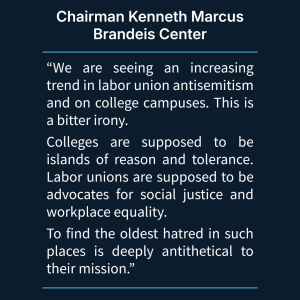
A growing number of medical professionals, teachers and local labor leaders are tolerating conduct that has made workplaces hostile for Jewish patients, students and employees. Documented cases – including discrimination and exclusion based on religion and ethnicity – have eroded trust in institutions meant to serve the public fairly and professionally. Leaders and professionals are exploiting their authority to advance ideological agendas, silence dissent and target Jewish colleagues and their allies.
Medicine and Mental Health: Ideology Enters the Exam Room
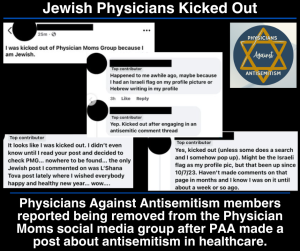
After the Iran-backed Hamas massacre of Israelis on Oct. 7, 2023, Jewish patients and healthcare professionals began reporting a rise in hostile and exclusionary behavior – especially among psychologists.
Chicago therapist Heba Ibrahim-Joudeh created a blacklist of “Zionist” therapists to avoid. Zionist often is used as a codeword for Jews – and it is unclear how the therapist knew the healthcare professionals were Zionists beyond their Jewish-sounding names. Ironically, she posted in a Facebook group named Chicago Anti-Racist Therapists: “I’ve put together a list of therapists/practices with Zionist affiliations that we should avoid referring clients to. Please feel free to contribute additional names as I’m certain there are more out there.” Her post received enthusiastic support.
These incidents align with growing concerns inside the American Psychological Association – the nation’s leading accreditor for psychological training. Last year, more than 3,500 mental health professionals signed a letter warning APA leadership of “serious and systemic anti-Jewish hate” – citing official educational conference statements and programs that included:
Former APA division president Lara Sheehi publicly described Zionism as a “settler psychosis” and posted messages calling to “destroy Zionism.” Villanova Univ. Counseling Center Director Nathalie Edmond portrayed Zionism as a form of psychological pathology – placing it on a “Colonized Mind” slide in a presentation, alongside fascism – treating Jewish identity as a condition to be corrected.
These concerns have reached federal authorities. The Brandeis Center recently led a meeting with the Office for Civil Rights director at the Health and Human Services Dept. The delegation included the American Jewish Medical Association, Hadassah, the ADL, Jewish Federations of North America and StandWithUs. ADL director Dan Granot: “Hospitals must remain places of healing, not hate.”
Recently in the UK, government healthcare workers marched in scrubs and chanted, “Kick the Zionists out,” while making a kicking motion with their feet. Also, in Australia, two former nurses, Sarah Abu Lebdeh and Ahmad Rashad Nadir, pleaded not guilty in court to charges of harassment and violent threats. During an interview, Nadir boasted, “You have no idea how many Israeli sh*t dogs have come to this hospital, and I sent them to hell,” and Abu Lebdeh also advocated violence: “I won’t treat them, I’ll kill them.”
Administrators and Educators: Tolerating Hatred in the Classroom
The National Education Association is committed to “championing justice,” “maintaining the highest professional standards” and providing “equal opportunity to all students.” The results conflict with a recent StandWithUs survey showing that the largest U.S. labor union continues to ignore concerns from its Jewish educators:
NEA Jewish Affairs Caucus Interim Chair Alyson Brauning: “These findings – while disturbing – do not come as a shock. They reveal a serious disconnect between stated commitments to equity and the lived realities of Jewish educators. Overt and subtle antisemitism continue to shape workplace environments in ways that undermine safety, belonging and professional participation.”
NEA President Becky Pringle recently was accused of ignoring Jewish concerns during a Holocaust education event. During the webinar hosted by the Jewish Council for Public Affairs, CEO Amy Spitalnick shared that Jewish NEA members “felt pain and fear at conventions where they were specifically targeted or ostracized simply for being Jewish.” Pringle did not respond. She also linked the Holocaust with today’s political activism and falsely accused Israel of committing genocide in Gaza.
The California Faculty Association circulated a questionnaire to political candidates in October asking whether they had accepted funds or endorsements from several organizations, including the Jewish Public Affairs Committee of California – a nonpartisan coalition of community groups. The CFA stated that it would not support candidates who accept donations from groups that “harm working people” – but JPAC does not fund candidates. JPAC includes nonprofits, professional associations and several progressive groups.
A landmark UN educational survey released on Holocaust Remembrance Day also reported troubling results: 78% of European Union teachers encountered at least one antisemitic incident among students – with 27% witnessing nine or more – and 42% of teachers witnessing anti-Jewish hatred from other teachers.
Labor Unions: Importing Campus Activism into the Workplace
Columbia Univ. graduate student, instructor and antizionist activist Johannah King-Slutzky was arrested during the 2024 campus encampment and takeover of Hamilton Hall. Now, she is helping lead a unionization effort at Israeli-owned Breads Bakery in NYC – despite never having worked for the company.
The union drive is moving beyond workplace conditions and into demands tied explicitly to Jewish communal life. The bakery workers who recently signed union authorization cards stating that their “struggle for fair pay, respect and safety is connected to struggles against genocide.” They called on the bakery to stop participating in the Great Nosh – an annual NYC Jewish food festival – and refused to bake cookies with an image of the Israeli flag. The workers signed with a local United Auto Workers union.
The Association of Legal Aid Attorneys (ALAA), a member of a different UAW local, recently settled a discrimination lawsuit brought by Louis Brandeis Center for Human Rights Under Law on behalf of three members. Union members targeted the plaintiffs – two Jews and one non-Jew – as “Zionist ghouls” for opposing a one-sided anti-Israel resolution. The Legal Aid Society – the actual employer of the ALAA staff – had called the resolution “laden with coded antisemitic language and thinly veiled calls for the destruction of the State of Israel.”


Addressing workplace discrimination requires deliberate engagement with institutional accountability, professional standards and civic participation that reinforce equal treatment under the law.

Stories Impacting American Jews
Stories Impacting the U.S. and Israel
Stories from Around the World
Stay Informed | Speak Up | Take Action

Want to Read More of Our Talking Points? Did you miss a recent edition of The Focus Project? No need to search your inbox. Our most recently published editions are available on our website.


This content is developed by The Focus Project in partnership with MERCAZ USA. The Focus Project distributes weekly news and talking points on timely issues concerning Israel and the Jewish people, including antisemitism, anti-Zionism and the delegitimization of Israel. It represents a consensus view across a spectrum of major American Jewish organizations. MERCAZ USA recognizes and respects the diversity of views on these issues among its readers and the community at large.