
January 6, 2026
BACKGROUND – TALKING POINTS – ACTIONS TO CONSIDER – STORIES MAKING NEWS


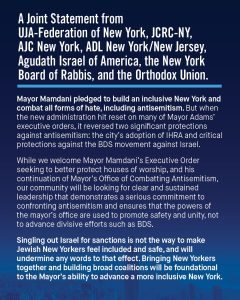
The newly elected NYC Mayor Zohran Mamdani’s early actions have heightened fears that protections against antisemitism are being weakened as hostility toward Jews escalates. New York City is home to the largest Jewish population outside of Israel.
Early Actions Signal a Shift Away from Combating Antisemitism
In his first days in office, Mamdani reversed key policies to protect Jewish communities from antisemitism. He revoked executive orders that adopted the International Holocaust Remembrance Alliance working definition of antisemitism, restricted city engagement with the Boycott, Divestment and Sanctions (BDS) Movement against Israel and provided guidance to the NYPD on handling protests near houses of worship. The new mayor’s actions struck down clear standards and safeguards at a moment of rising anti-Jewish hostility.
Mamdani’s team also deleted social media posts on combating antisemitism – posted by the previous mayor – from the official NYC Mayor’s account, erasing public commitments to confronting anti-Jewish hate and raising questions about legality and transparency.
The mayor publicly stated that the Mayor’s Office to Combat Antisemitism will remain in place – but its current director, Rabbi Moshe Davis, reported that he had not heard from the mayor’s staff and city officials declined to clarify its status. The absence of engagement or guidance fueled concerns about the status of the office going forward.
Mamdani also appointed a new chief counsel who previously coached hardline anti-Israel protesters and defended an Al Qaeda terrorist in court. At least 20% of the mayor’s appointees have ties to anti-Zionist groups.
Extremist Allies and Authoritarian Sympathies
Mayor Mamdani’s student and political activism have drawn support from activist groups and movements that promote aggressive anti-America and anti-Israel activity. This includes the Democratic Socialists of America – his political party.
When Venezuelans and their diaspora communities in the U.S., the UK and other countries were cheering the recent removal of the country’s authoritarian dictator from power, the Democratic Socialists of America demanded his release and declared: “Solidarity with the Bolivarian Revolution!” The same activists who claim to champion human rights defended a brutal regime responsible for repression and suffering.
Antizionism = Antisemitism
The International Holocaust Remembrance Alliance working definition of antisemitism is widely used by governments around the world to identify incidents of anti-Jewish hatred as they arise. It exists because modern antisemitism increasingly disguises itself as political activism.
The definition is used by the U.S. State Department, federal agencies, state and local governments, and universities as a practical tool for recognizing patterns of antisemitism. It is the most widely accepted framework used by Jewish communities and democratic governments worldwide.
Under IHRA, antisemitism includes not only hostility toward Jews as individuals – but also forms of antizionism:
Governments and organizations rely on this definition because these acts have been repeatedly used to justify real-world targeting of Jews and Jewish institutions. The massacre of 15 Jews during Hanukkah in Australia highlighted this pattern.
Mamdani has publicly supported the BDS movement against Israel and aligned with anti-America and anti-Israel activist groups whose rhetoric and tactics meet multiple IHRA criteria. By revoking IHRA’s use in NYC, Mamdani removed the standard that identifies and limits this conduct.
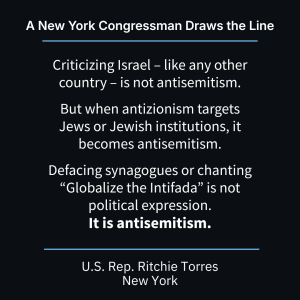
The antisemitism definition draws a clear and necessary line where political claims become collective discrimination against Jews based on national origin, religion or false accusations. When that line is crossed, the harm is no longer theoretical – it is lived by Jewish communities. IHRA makes clear that “criticism of Israel similar to that leveled against any other country cannot be regarded as antisemitic.”
From Rhetoric to Reality: When Antizionism Targets Jews
Anti-Western activists have repeatedly protested outside Jewish houses of worship and community events, chanting slogans that promote violence against Jews – “Globalize the Intifada” – under the guise of targeting “Zionists.” These demonstrations have disrupted worship and endangered Jewish families, including children.
They intentionally use the term “Zionist” as a stand-in for Jews to avoid being labeled as antisemites. Zionism is a core component of Jewish identity, religious practice and peoplehood. Jewish prayer, worship and rituals center on Jerusalem, Jewish holidays commemorate returning to Israel and Zionism reflects Jewish self-determination. Targeting “Zionists” in Jewish spaces is the equivalent of targeting Jews.


Strengthening community safety reinforces accountability and makes clear that protecting houses of worship is a shared civic responsibility.

Stories Impacting American Jews
Stories Impacting the U.S. and Israel
Stories from Around the World
Stay Informed | Speak Up | Take Action

Want to Read More of Our Talking Points? Did you miss a recent edition of The Focus Project? No need to search your inbox. Our most recently published editions are available on our website.
This content is developed by The Focus Project in partnership with MERCAZ USA. The Focus Project distributes weekly news and talking points on timely issues concerning Israel and the Jewish people, including antisemitism, anti-Zionism and the delegitimization of Israel. It represents a consensus view across a spectrum of major American Jewish organizations. MERCAZ USA recognizes and respects the diversity of views on these issues among its readers and the community at large.