
December 16, 2025
BACKGROUND – TALKING POINTS – ACTIONS TO CONSIDER – VOICES – STORIES


Hanukkah is the story of the Jewish people who refused to abandon their identity, faith and history in the face of persecution. From ancient Jerusalem to the present day, the lighting of the menorah has marked not comfort or ease, but perseverance – a shining affirmation of Jewish existence and resilience against rising threats and attacks targeting Jews around the world.
Australia: Islamist Terror Shatters Hanukkah Celebration
During a joyful Hanukkah festival near Australia’s world-famous Bondi Beach, a hail of gunfire turned celebration to horrific tragedy. At least 16 men, women and children were murdered and dozens more injured.
“It was an absolute bloodbath, blood gushing everywhere,” human rights lawyer Arsen Ostrovsky reported, describing the horror unfolding during a peaceful Jewish celebration. The Australian – who survived a gunshot wound to the head – moved back from Israel two weeks ago to help lead the fight against anti-Jewish hatred in Australia. He continued: “It was chaos. I saw people hit, fall to the ground. My only concern was, where are my kids? Where are my kids?”
Two Islamist terrorists – a father and son, Naveed and Sajid Akram – intentionally targeted Jews in the nation’s deadliest terror attack. The assailants were armed with six rifles and knives, and police later found bombs and Islamic State (ISIS) flags in their car. The son was a follower of an Australian imam whose lectures vilifying Jews were removed from the internet earlier this year.
The victims spanned generations and backgrounds, including a 10-year-old girl, respected rabbis, a Holocaust survivor and other community members whose lives were rooted in faith, family and public service. The event was organized by Chabad – an international Jewish organization with more than 6,000 emissaries in more than 100 countries – known for its outreach to both religious and non-religious Jews.
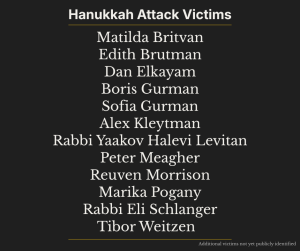
Matilda Britvan, 10, was remembered as a “joyful child who brought light to everyone around her.” Chabad Rabbi Eli Schlanger, 41, was outspoken about the Australian government’s failure to respond to growing safety concerns from the Jewish community. In response to rising anti-Jewish hatred, he encouraged Jews to be “more Jewish, act more Jewish and appear more Jewish.” Alex Kleytman, an 87-year-old Ukrainian Holocaust survivor, was celebrating Hanukkah with his wife of 57 years. Larisa described how her husband was “shot in the back of the head because he raised himself up to protect me.”
Amid the carnage, two individuals emerged as heroes. Ahmed al-Ahmed, a 44-year-old Muslim father of two, snuck up on the older terrorist and wrestled away his rifle. Ahmed was later shot twice and underwent surgery for his wounds. Boris Gurman, 69, also wrestled a rifle away from Sajid Akram when the terrorists emerged from their car before the attack. Unfortunately, the terrorist retrieved another gun and killed Boris and his wife, Sofia.
Australia was long regarded as one of the safest places for Jews living in the diaspora. That sense of security eroded in recent years after arson attacks against synagogues, chants promoting violence and actions to exclude “Zionists” from public places. For many Australian Jews, the Hanukkah massacre marked a devastating confirmation that the threat had reached a new, deadly level.
Warnings Ignored: ‘Writing was on the wall’
Only days before the terror attack, leaders from the world’s seven largest diaspora Jewish communities concluded a conference in Australia. Representatives from Argentina, Australia, Canada, France, Germany, the UK and the U.S. met to “show our solidarity with the Australian Jewish community and reiterate our call on our governments to ensure the security of the Jewish community.”
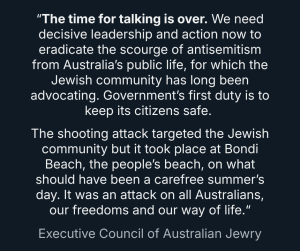
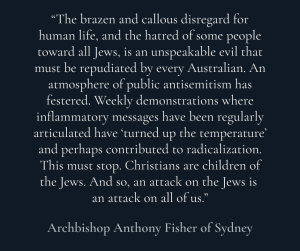
The Australian government repeatedly failed to act on clear warning signs following attacks and escalating threats against the Jewish community. Alex Ryvchin, co-CEO of the Executive Council of Australian Jewry, was targeted earlier this year when an assailant firebombed his former home. Following the Hanukkah attack, he stated: “The writing was on the wall. We look to our government to keep us safe, to set the tone, to lead. And clearly, there’s been a colossal failure.”
Attacks in California: Shots Fired at Jewish Home, FBI Prevents Bombings
Attacks against Jews are not limited to any one country or community. A recent shooting and foiled bomb plot illustrate how extremist violence crosses borders, ideologies and targets.
In California, a driver pulled up to a Jewish family’s house decorated for Hanukkah and fired about 20 bullets. The gunman yelled, “f*ck Jews,” as he drove away from the home in Redlands, 60 miles east of LA. Jonpaul Yohanan Cohen stated that a person yelled “Free Palestine” and the “n-word” at him when he entered his car, moments before the shooting. His brother, sister, mother and grandmother were in their home at the time of the attack.
The FBI arrested five members of a radical left-wing pro-Palestinian group plotting New Year’s Eve bombings against multiple businesses in Southern California – the same group that helped organize the recent violent protest at an LA synagogue. The suspects are members of the Turtle Island Liberation Front that is dedicated to the destruction of America and Israel. The FBI found posters stating, “Death to America, Long Live Turtle Island and Palestine.”
Globalize the Intifada: ‘Kill the Jews and the Christians’
Former Israeli hostage Omer Shem Tov explained what his Hamas terrorist captors told him: “They never mentioned land. They always told me it’s about religion. They always told me that their goal after they kill Jews in Israel: they will go around the entire world to kill the Jews and the Christians.”
Recently, German police arrested five men for planning an attack on a Christmas market. The five arrested included an Egyptian imam, a Syrian and three Moroccans, ages 22 to 56. Also, Polish police arrested a university student for plotting a Christmas market attack on behalf of Islamic State and French officials cancelled the annual New Year’s Eve event in Paris over fears of violence.
Islamic State and other terror organizations also are very active in Africa. The Boko Haram terror group and its allies in Nigeria have murdered more than 50,000 Christians, torched 18,000 churches and uprooted 800 communities since 2009.
This ideology also manifests in the intimidation of Jewish religious life in public spaces. Only hours after Australia’s Hanukkah massacre, Dutch police arrested 22 pro-Palestinian activists at a protest of an Amsterdam Hanukkah concert – even after the IDF cantor (prayer singer) was excluded from the public performance.
Hanukkah: Jewish Identity and Enduring Light
In this world of spiraling hate, Hanukkah’s historical meaning – rooted in identity, memory and perseverance – takes on renewed relevance.
Hanukkah commemorates the Maccabean revolt against the Greek Empire in the second century BCE, when a small Jewish force reclaimed Jerusalem and rededicated the holy Jewish Temple in Jerusalem after it had been desecrated. According to Jewish tradition, a single day’s supply of oil burned for eight days in the restored Temple – a moment remembered by Jews through the lighting of the menorah each night of the annual eight-day holiday.
A recently released video offers rare documentation of Jewish religious expression carried out under extreme duress. In 2023, six Israeli hostages imprisoned in a Hamas tunnel – all brutally murdered months later – were forced to film a propaganda video in which they lit Hanukkah candles, sang a Hanukkah song and discussed the role of religion in their lives.
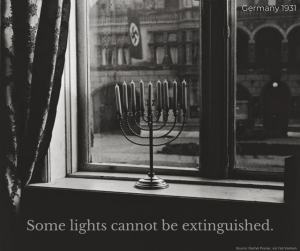
One of the six hostages, American Israeli hostage Hersh Goldberg-Polin, had compared their conditions in Gaza to the Jews living in Nazi Germany. During Hanukkah in 1931, Rachel Posner photographed her family’s menorah on a windowsill in Kiel, Germany, facing a building draped in Nazi flags. On the back of the photo, she wrote, using Judah as a Biblical name for the Jewish people: “‘Death to Judah,’ so the flag says. ‘Judah will live forever,’ so the light answers.”





Stories Impacting American Jews
Stories Impacting the U.S. and Israel
In Memoriam
Rob Reiner: Hollywood giant behind slew of iconic Hollywood films, 78
Stay Informed | Speak Up | Take Action

Want to Read More of Our Talking Points? Did you miss a recent edition of The Focus Project? No need to search your inbox. Our most recently published editions are available on our website.
This content is developed by The Focus Project in partnership with MERCAZ USA. The Focus Project distributes weekly news and talking points on timely issues concerning Israel and the Jewish people, including antisemitism, anti-Zionism and the delegitimization of Israel. It represents a consensus view across a spectrum of major American Jewish organizations. MERCAZ USA recognizes and respects the diversity of views on these issues among its readers and the community at large.